Why Logging On Alone Feels Easier Than Playing With the People You Actually Like

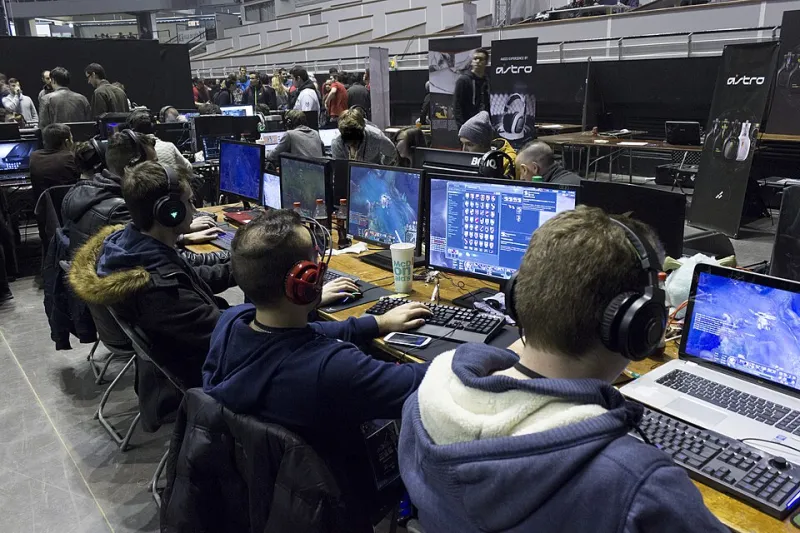
Photo: Fanart,TV, CC0, via Wikimedia Commons
Let me describe something you might recognize.
Your friend texts you on a Friday night asking if you want to jump into a few rounds of something. You like your friend. You like the game. But something in your chest tightens a little, and you find yourself making up a reason you can't — or just leaving the message on read until the moment passes.
Then, an hour later, you're playing the exact same game. Alone.
If that sounds familiar, you're not broken and you're definitely not alone. There's a growing undercurrent in gaming culture that doesn't get talked about enough: the social anxiety that multiplayer gaming quietly generates, even — maybe especially — among people playing with friends.
The Pressure of a Familiar Audience
Here's the counterintuitive thing about playing with strangers versus playing with people you know. Strangers are, in a weird way, lower stakes. If you have a terrible game against random opponents in a public lobby, they log off and forget you existed in thirty seconds. Nobody who knows your name saw it happen.
But play badly in front of your actual friends? That sticks around. It becomes a reference point. "Remember when you drove the car off the map?" It's meant affectionately — usually — but the awareness that your performance is being witnessed and remembered by people whose opinions of you actually matter changes how the experience feels.
Psychologists call the broader phenomenon "evaluation apprehension" — the anxiety that comes from knowing you're being watched and judged, even by people who like you. Gaming creates an unusually pure version of this because the feedback is so immediate and so visible. Every missed shot, every wrong decision, every moment of confusion plays out in real time for your whole squad to see.
Skill Gaps Hit Different When It's Personal
Among strangers, a skill gap is just matchmaking noise. Among friends, it becomes a whole thing.
Maybe your friend group has been playing a particular shooter for two years and you're just getting into it. Maybe you took a few months off and fell behind the meta. Whatever the reason, the experience of being clearly the weakest player in a group of people you care about is genuinely uncomfortable in a way that solo play or random lobbies never quite replicates.
Worse, the social dynamics around skill gaps in friend groups are weirdly fraught. Nobody wants to be the person who asks to be carried. Nobody wants to feel like they're dragging their team down. And nobody wants to be the experienced player who has to decide between playing optimally and slowing down to make the session fun for everyone.
Those competing pressures — perform well, don't stress anyone out, have fun, don't be a burden — are a lot to hold simultaneously. And a lot of casual players, often without consciously articulating it, decide it's just easier to play alone.
Decision Fatigue Is a Real Multiplayer Tax
Beyond performance anxiety, there's another quieter drain that squad play puts on players: the sheer cognitive and social weight of coordination.
Solo play is simple. You make decisions. Things happen. You respond. The feedback loop is clean.
Multiplayer with friends adds a layer of social negotiation on top of every in-game decision. What do we play? Who picks the mode? Do we take this seriously or are we just messing around? Is it okay to quit if this match goes badly? Are we on comms or just vibing?
None of these are big questions individually, but they stack up. And for players who are already a little socially drained from work, school, or just existing in 2025, that extra cognitive load can make solo play feel like a genuinely restful alternative — even when they'd theoretically enjoy playing with friends more.
Have Games Made This Worse on Purpose?
This is where it gets worth asking some harder questions about game design.
Modern multiplayer games are, in many ways, optimized for competitive engagement over casual accessibility. Ranked modes, visible performance stats, kill/death ratios, damage numbers floating over every enemy — these systems are great for players who want to measure and improve. But they also make every session feel like a performance review, which is the last thing a casual player needs when they're trying to unwind.
The rise of voice communication as an expected feature rather than an optional one has also quietly raised the social stakes of multiplayer. Not being on comms in a squad game can feel like a social slight. Being on comms means being heard, being judged on your callouts, your reactions, your vibe. That's a lot of exposure for someone who just wants to shoot things for an hour.
Game designers have started paying more attention to this. Titles that offer clear casual modes with reduced social pressure — no voice required, no visible stats, low-stakes matchmaking — tend to see broader participation from players who would otherwise sit out entirely. But the competitive framework is still the default in most major multiplayer releases, and casual players are still treated as an afterthought.
The Solo Session as Self-Protection
None of this means people who prefer solo play are antisocial or struggling in some clinical sense. For most players, it's just a reasonable response to a set of social pressures that multiplayer gaming has normalized without really examining.
Choosing to play alone sometimes is a form of self-regulation — protecting your energy, avoiding situations where you feel exposed, giving yourself permission to be bad at something without an audience. That's healthy, actually.
But it's worth recognizing that when millions of people are quietly opting out of playing with their friends because the social cost feels too high, that's at least partly a design problem. Games that are supposed to bring people together are, for a meaningful portion of their audience, doing the opposite.
The fix isn't complicated. Give casual players real spaces to exist. Make skill gaps less visible. Let people play together without it feeling like a job interview. Make voice chat optional without making it feel like you're opting out of the social contract.
Most people don't actually want to log on alone. They just want playing with friends to feel worth it again.