Why Six-Player Lobbies Are a Matchmaking Nightmare Nobody Talks About
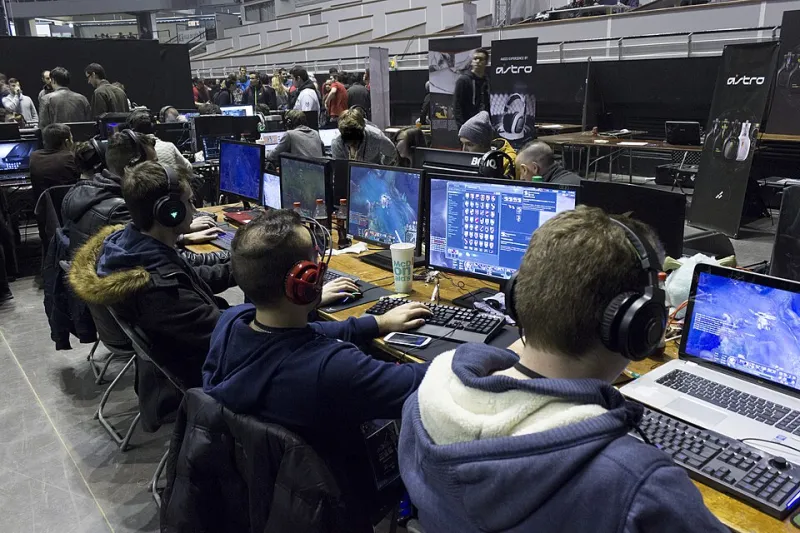
Photo: This picture belongs to Xavier Caré. Please credit : Xavier Caré / Wikimedia Commons / CC-BY-SA. If you would like special permission to use, license, or purchase the image please contact me to negotiate terms. I'd appreciate if you could let me kn
Six is a number that feels intuitively right. It's small enough to feel personal, large enough to feel like a team. Board games love it. Poker tables are built for it. And yet, when online game developers try to design around it, things have a funny way of falling apart.
If you've ever waited forever to find a match in a game that supports six-player modes — or noticed that your favorite title quietly dropped that format after launch — you've already bumped into this problem without realizing it. The six-player lobby is, quietly and persistently, one of the more stubborn headaches in multiplayer game design.
The Math That Works Against You
To understand why six is awkward, you have to start with how matchmaking actually works under the hood. Most modern matchmaking systems are built around powers of two. Four players. Eight players. Sixteen. There's a reason for this: splitting teams becomes trivially clean. Four players? Two teams of two, or one team of four. Eight? You've got endless clean configurations. The server infrastructure that routes player data, balances ping, and assigns roles was largely designed with these numbers in mind.
Six breaks that symmetry almost immediately. Split it evenly and you've got two teams of three — which sounds fine until you realize that three-on-three competitive formats are notoriously difficult to balance. One skilled player on a three-person squad has an outsized impact compared to the same player on a team of four or five. The variance in match outcomes skyrockets, and ranked modes become nearly unplayable for anyone trying to climb a ladder seriously.
You can go three-versus-three, sure. But you can also go two-versus-four, which is obviously unfair. Or you try six-player free-for-all, which introduces its own chaos — kingmaking, target fixation on the leader, and the eternal problem of what happens when someone rage-quits and you've got five left.
Real Games, Real Headaches
This isn't theoretical. Look at the history of six-player modes across popular titles and you'll find a graveyard of abandoned experiments.
Rocket League has flirted with six-player modes in its 3v3 standard format, but the moment you push toward anything asymmetrical, the competitive community revolts. The game's physics engine was tuned for specific player counts, and adding even one more body to each side fundamentally changes rotation patterns and positioning logic that pros have spent years mastering.
Apex Legends runs on three-player squads deliberately. The development team at Respawn has been vocal over the years about why they landed on trios over duos or larger squads — three creates a natural dynamic where one player can be downed without the team being completely crippled, but the group is still small enough that individual performance matters. Scaling that to six introduces a coordination tax that casual players can't absorb and competitive players resent.
And then there's the battle royale genre broadly, where lobby sizes are enormous by design — 60, 100, 150 players — specifically because those numbers allow for gradual attrition that keeps matches feeling dynamic. Six-player battle royales have been tried and they tend to feel either too short or too chaotic to sustain interest.
The Server Side of the Problem
Beyond game design, there's a backend infrastructure argument that developers don't talk about publicly very often. Servers are typically provisioned in configurations that mirror team sizes. When you're running eight-player lobbies, you can pack players into server slots efficiently. When you're running six-player lobbies, you end up with what engineers sometimes call "orphaned capacity" — server resources allocated to a lobby that never quite fills to the next clean breakpoint.
This becomes a real cost issue at scale. A game with millions of daily players running inefficient lobby sizes can burn through server budget in ways that are genuinely hard to justify to a finance team. It's one of the less glamorous reasons why you'll sometimes see a game's six-player mode quietly sunset after a season or two — not because players hated it, but because it cost too much to run relative to the engagement it generated.
The Competitive Balance Trap
Here's the part that stings for designers who genuinely want six-player modes to work: even when you solve the math and absorb the server costs, you run into competitive balance problems that are almost philosophical in nature.
In a four-player team game, roles tend to distribute naturally. Someone tanks, someone supports, someone deals damage, someone controls space. In a six-player team, you need either more roles (which increases complexity and learning curves) or role redundancy (which creates debates about who plays what). Neither solution is clean.
Games that have made six-player team formats work — and there are some — tend to do it by leaning hard into chaos rather than fighting it. Titles that embrace a more casual, party-game energy can get away with six players because nobody's expecting pristine balance. But the moment a game tries to attach ranked progression or esports ambitions to a six-player format, the cracks show fast.
Is There a Fix?
Developers who've wrestled with this problem tend to land in one of two camps. The first group says the answer is adaptive matchmaking — systems smart enough to modify game rules on the fly based on who shows up. If only five players are ready, the game adjusts team sizes or adds a lightweight AI fill-in. This works better in theory than practice, because players hate losing to bots and love complaining about inconsistent rule sets.
The second group says the answer is just to pick a different number. Four. Eight. Don't fight the math. It's not a satisfying answer, but it's the one that shipping games tend to arrive at.
For now, six-player lobbies sit in a weird middle space — too appealing conceptually to abandon entirely, too structurally awkward to implement cleanly. Every few years a new game announces a six-player mode with confidence, and every few years we watch it quietly disappear from patch notes.
Some numbers just don't play nice. Six might be the most stubborn of all.